🧾 What Is a Tariff?
A Tariff is basically a tax that one country puts on things it buys from another country.
Let’s say America buys steel from China. If the U.S. government adds a 25% tariff, it means American companies now have to pay 25% extra when buying Chinese steel. So, it becomes more expensive. That’s how the U.S. makes imported items costlier, to protect its own companies.
💡 Why Does the U.S. Put High Tariffs?
Here’s why America—and other countries too—use high tariffs:
1. To protect their own industries
If Indian goods (like cheap textiles or auto parts) are coming into the U.S. at low prices, American companies may not be able to compete. So, the U.S. adds tariffs to make imports costlier, giving local businesses a chance to survive and grow.
2. To punish unfair trade
If a country (like China) is selling goods too cheap (even at loss) just to kill competition—called dumping—the U.S. uses tariffs to stop that.
3. For national security
In 2018, the U.S. put tariffs on steel and aluminium, saying depending on foreign metal was risky for its defense and infrastructure.
4. To pressure other countries
Sometimes the U.S. uses tariffs like a weapon—to pressure other countries to change their trade rules, or open their markets for American companies.
📘 A Real Example: U.S.–China Trade War
What happened?
- In 2018, the U.S. said China was stealing technology and trading unfairly.
- So, the U.S. added high tariffs on Chinese goods (like electronics, steel, machinery).
- China replied by putting tariffs on American products—especially farm goods like soybeans and pork.
This went on for 2 years—called a trade war.
Who suffered?
- U.S. farmers couldn’t sell to China anymore. They lost money.
- American companies that use Chinese parts (like Apple, car companies) saw costs go up.
- Consumers in the U.S. had to pay higher prices on everyday items—TVs, fridges, clothes.
- Even Indian companies exporting raw materials to China saw some impact because global trade slowed down.
🔁 So, What Are the Good and Bad Sides?
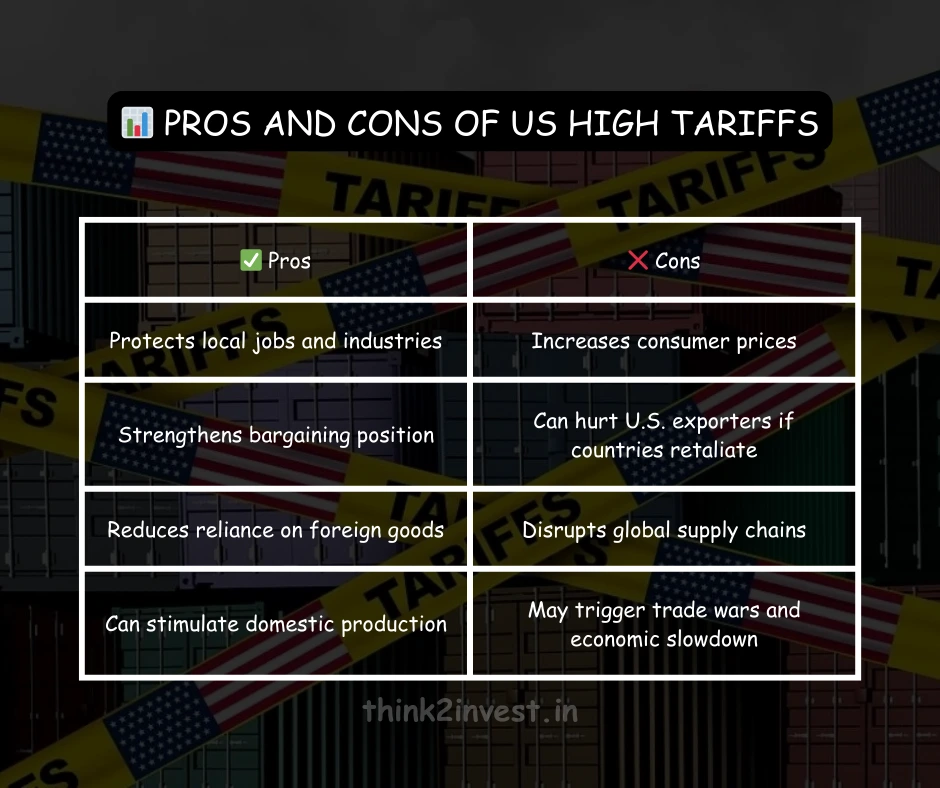
✅ Good Side (Pros)
- Protects jobs in the U.S.
- Helps local industries grow.
- Puts pressure on countries to trade fairly.
❌ Bad Side (Cons)
- Prices go up for people in the U.S.
- Other countries (like China) hit back with their own tariffs.
- It affects global trade and supply chains.
- American companies that depend on foreign parts face losses.
🌏 What Do Other Countries Think?
Countries like India, China, the EU, and Canada don’t like sudden U.S. tariffs, especially if they feel it’s unfair. Many take the U.S. to the World Trade Organization (WTO), asking them to stop.
Sometimes, countries even say, “If you put tariffs on our goods, we’ll put tariffs on yours.” This tit-for-tat situation leads to trade wars—which is bad for everyone.
What Does This Mean for India?
- India also faces U.S. tariffs on some exports like steel, aluminium, and auto parts.
- If the U.S. puts high tariffs on Chinese goods, some Indian companies benefit—because they can sell in place of China.
- But trade wars reduce global demand, so Indian exporters also feel the heat.
How Do U.S. High Tariffs Affect India?
Even though the U.S. mainly targets countries like China, India also gets affected—directly and indirectly. Here’s how:
🔻 1. India’s Exports to the U.S. Become More Expensive
If the U.S. puts tariffs on Indian goods like steel, aluminum, auto parts, textiles, or electronics, those goods become costlier in the American market.
Real Example:
- In 2018, the U.S. imposed 25% tariffs on Indian steel and 10% on aluminum.
- Indian metal exporters suddenly became less competitive, and their U.S. orders dropped.
- That hurt jobs and income in India’s steel-producing states like Jharkhand, Odisha, and Chhattisgarh.
🔁 2. India Lost Special Trade Benefits (GSP Program)
For many years, Indian exporters enjoyed a zero-duty advantage under the U.S. GSP program (Generalized System of Preferences). In 2019, the U.S. ended India’s GSP benefits, affecting $6 billion worth of Indian exports like:
- Leather goods 🥿
- Engineering products 🛠️
- Handicrafts 🎨
- Processed food 🍪
This made Indian goods more expensive and less attractive in the U.S., hurting small and medium businesses.
💼 3. Opportunities When China Gets Hit
Here’s the good news: when the U.S. slaps tariffs on Chinese goods, American buyers start looking elsewhere. India can benefit!
Example:
- U.S. imposed tariffs on Chinese electronics and mobile components.
- Indian companies like Lava, Dixon Technologies, and others gained new contracts for assembling or supplying electronics.
- Textile and apparel exporters also got more interest from U.S. brands avoiding China.
🌐 4. Global Trade Slows Down – India Indirectly Hit
Trade wars make global markets unstable. When giant economies like U.S. and China fight, global demand slows, hurting Indian exports too—like IT services, machinery, and raw materials.
📉 5. Currency & Stock Market Volatility
Trade tensions can shake investor confidence. It affects:
- INR value (rupee can weaken).
- Sensex/Nifty may fall due to global worries.
- Foreign investors might pull out money from Indian markets.
| 🔹 Impact Type | 🇮🇳 Effect on India |
|---|---|
| U.S. tariffs on Indian goods | Indian exports drop, prices rise in U.S. |
| GSP withdrawal | Loss of duty-free access for Indian products |
| China targeted | India gets new opportunities to replace China |
| Global slowdown | Lower demand for Indian exports |
| Market volatility | Stock market and rupee may get affected |
💡Final Thoughts
If India can improve manufacturing quality, ease of doing business, and trade logistics, it has a real shot at grabbing market share in the U.S.
U.S. high tariffs are like a ripple in a pond—even if India isn’t the direct target, the waves reach Indian shores too. While some Indian businesses may lose exports, others may gain new chances as global supply chains shift.